
Sometime ago, I was tasked with writing a text on the topics of improvisation and politics. I first considered writing on the spontaneous series of musical interventions at a few anti-government protests in Ljubljana in 2013. In their affective immediacy, these events direct to the selected topics overtly. But as it turned out, these improvisations in public space, did not become the subject of my writing, and neither do I intend to rehash the subject extensively at this occasion. The associations brought by these events might, from the rather worn-out point of view that aims to establish political implications of this or that artistic practice, appear rather self-evident. But I will use them as a starting point for the turn to the more 'natural' circumstances in which free music begins to take on a life of its own.
The course of action: At the end of 2012 and throughout 2013, political movements and demonstrations against the government and, at least indirectly, against the way of handling the then-still-fresh financial crisis, were multiplying in Slovenia. With some distance, and without any pretension of analytical accuracy, I can name two characteristics or dilemmas of the uprisings: occupying places and mistrusting the existing representative political bodies, namely parties. Among other things, the latter dilemma was expressed clearly in the slogan 'Gotof si!' (Eng: You're done!). In both cases, the actual tensions and the reflections covered extensively by the media were swirling around issues on understanding 'the masses' that could not be easily integrated into parliamentary politics. Was the occupation of public space only symbolic, and in its purpose a temporary gesture, a sort of 'sit-in', used by a movement to bring awareness to a certain problem? Or was it rather a beginning of the formation of an autonomous community with a more permanent goal in mind? Does the rejection of representivity reveal the search for alternative options of political organisation or does it express the demand for a new political party? Is the uprising as such already an articulation of the masses’ actual political contents and goals – or is it merely a societal symptom that only becomes a political force through organisation, in which the symptom will be appropriately expressed?
The scenography of the uprisings was ever-changing. More than once, the question arose on what the uprising could sound like. The gatherings were soon equipped with a stage; on the sound level, the stage acted as an amplifier of facts and a unifier of the masses' voices. But even before the focus was placed on oratorical and musical stages, there were several occasions in which a group of three or four local impro and free jazz musicians took up the space in the middle of the crowd. They played together energetically, not paying particular attention to protestors. The protestors, in turn, returned their attention with equal measure. At first glance, the scene of such improvisations in public space seems clear; the musicians played among the people, so they were also part of the political crowd. Through improvisation, then, the musical expression of freedom directly entered the political scene and became its part. In doing so, the musicians never established themselves as opposing the stage. The latter revealed the attempt to impose the not-necessarily-well-thought-through tendency to unify and represent the masses. The musicians simply did not care about these tendencies.
Such a starting point can have several issues; describing the uprisings through these dilemmas can appear reductionist, and further, such an approach forces its own scheme onto the musical gesture. This scheme is revealed in the opposition between being-part-of-the-masses and being-part-of-the-stage. Too quickly, such an opposition invites the notion that improvisation negates all forms of organisation, order and structure. Rather than search for analogies, however, it is possible to switch the distance established between the stage and the masses in the political situation above. This distance then, can be used to reflect on the relations within music and the 'scene' itself. This way, rather than ask how improvisers enter the political scene, the question becomes: how do they exit the concert situation?
But what even is a concert situation? When deliberating on the sideways and possible political effects of improvised music, Mattin, writer and noise artist, recognises the interactions of active participants in an improvised situation. In this way, he argues, 'the performance space can be the place in which according to the intensity of it, new subjectivities might arise.'[1] When entering improvised play, musicians become part of an unpredictable situation, made up of sound events and the responses to them. In navigating this situation, they are guided by the imperative to avoid repetitions and the patterns they have been taught. The 'new subjectivities' are woven together by an interactive play of listening and responding. This presupposes a specific ethical stance of the musicians, or rather, their commitment to both their co-players and the events around them. Mattin therefore speaks of 'subterranean ethics'; never completely emptied of the influence of the surroundings and the principles which construct individual 'schools' of improvisation. In conceptualising 'subterranean ethics', Mattin uses Alan Badiou's idea of an 'ethic of truths', where contrary to the traditional understanding of ethics as a philosophical discipline, ethics is conceptualised as practical commitment to singular events. Only through engaged subjective action can these singular events effectuate real change of the existing order . Such singularities can be accompanied by a feeling of surprise or by an accidental encounter, but persistance on their transformative power is not grounded in previously estasblished beliefs or rules of action.
Given this uncertainty, musical improvisation is not only about the provocation or an intervention in the concert situations, where the commitment to freedom and avoiding formal rules of specific genres can also be recognised. The positive side of this freedom must also be accompanied by the negative one; the musician-improviser has no aesthetic, formal, institutional or even economic guarantee that what they are doing is in fact an artistic creation. When Badiou discusses the eventual encounter, he sometimes describes it as an individual ‘entering into the composition of a subject’, thus allowing its effects to occur. The existence of such a subject can be thought of as a cut in individuals’ habits or rituals, in which both his identity of the musician-virtuoso and the formal principles of the musical genre can be based. Metaphorically, Mattin here incorporates the categories of speech. However, I understand the possibility of such 'subjectivities' as something that originates in the interactions between musicians, the instruments and the sounds – the differences and displacements, developed in time through sound events. These interactions exist both in space and in time only in a 'concert situation'. Only in relation to the concert situation is it possible to discuss the formation of music and occuring of a subjectivity – without any external guarantee that these formations in fact took place.
What then is a concert situation? In improvisation, a different situation practically does not exist. However, performing live means the presupposition of space; at once an infrastructural and acoustic condition. Even if improvisation does not require a stage, it is carried out in the relationship with the audience (the number of the people in the audience, even when no one is there, is secondary here). An improvised situation presupposes the possibility of encounters and exchanges of both experiences and concert opportunities between musicians, the organisers' support, and their forms of communication with 'publics'. Last but not least, it also produces, through critique and other forms of discussion, a discourse on improvisation. Said gently, we usually claim that just like any other musical or artistic practice – it simultaneously requires and generates 'the scene'. Said less gently, the very practice of improvisation in 'the scene' can only occur within a given network of its own economic conditions.
The two descriptions of the 'concert situation'; the ethical and economic, with their corresponding actors – the 'subject' and the 'scene' – are mutually presupposed. Thus put, the two aspects may be easily perceived as contradictory. But the ‘scene’ is experienced here as an entirely organic, social, loose-market activity, made up precisely by a shared desire, originating in its subterranean ethics. The actual conditions prevalent at least in the Slovenian circumstances, mainly force the actors active on the scene into the position of state-subsidised ‘self-employed cultural workers’ or into smaller formalised collectives, economically bound to tender specifications for financing the various extents of their activities. The contradictions in which both the scene and its ‘ethical’ undergrounds enter deserve a more precise empirical treatment that will not be provided here. What I can offer is merely a short speculation on the various positions encountered by the aspect of the situation that is closest to me: a reflection on, and more broadly, the outlines of the very production of discourse which often appears in the form of critiques or review texts.
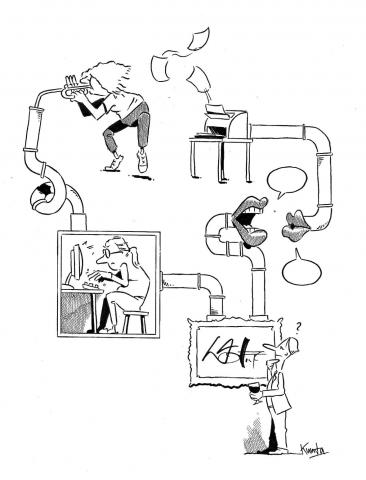
This position is without doubt torn between both layers of the situation. Let us say; we behave on ‘the scene’ as if ‘subjectivity’ always exists, that concert line-ups, together with the promise of a social event always move in the field of predictability, and that the success of a performance is either confirmed or denied in a critical response, various institutions value the performances as products of an author, and tender-based financing can influence both the tempo and the quantity of such production. Every text that appears on ‘the scene’ enters the personal archive of the author and/or producer for future calls for project applications – here, the quantity, not the contents of the texts are relevant. The content only becomes relevant in the number of times a specific actor or organisation is mentioned. Every text is therefore a PR text. The discourse circulating on the scene is an empty discourse. Perhaps emotions are put into it, some mutual recognitions are expressed, but in the last instance, these are entirely internal to the scene and its economy. Discourse represents the ethical side of the scene, for the scene, and speaks of music in places where music is silent. Put in the words of Derek Bailey in his book on improvisation: to improvise is to play, but to speak of improvisation, one must stop playing.
If there is one position possible here, the second option does not succumb to PR logic, and takes into account both layers of the situation. Discourse then, is still part of the scene and its economy here, but it is not separated from the ethical layer. How? By sticking to the form, bound to a particular event of the concert, in a direct relationship, led by the ethics of the event, by taking on parts of the ethics’ uncertainty. The relationship of discourse toward music is hence necessarily the reflection of its relationship toward knowledge. Who knows, that a concert situation has achieved a breakthrough, something that signifies the exit of the actors from the field of the known into something that only belongs to a given situation? Its participants know. But because this knowledge is imbued with insecurity in the absence of hard objective criteria that would discern between a good and bad gig, this knowledge must be shared and confirmed between the participants themselves. Discourse is what happens after the gig between its participants. To speak of improvisation, to interpret it, is also a part of it, although there is still some separation between the two activities.
Third possibility: none of this suffices, since the belief of participants that their non-profitable passions make them part of something meaningful does not cancel out the uncertainty and absence of objective criteria. Rather, this belief collectivises this absence. When a multitude of impressions and opinions circulates between people on ‘the scene’, the multitude might even become homogenised. But what circulates is still the shared unknowing of the sense and meaning of the event witnessed. This unknowing can only be dispelled by an authority with the power to determine the meaning. By doing so, the authority might cause resistance and objections in a certain part of the scene – but the resistance and objection are formed and triggered only in response to the authority’s words. A possible outcome of such an occurrence would result in a situation in which musicians themselves do not know what they are doing and hence the effects of their actions can only be read in the responses of a critic or local expert who somehow managed to occupy this position. The more confident among the musicians can garner a healthy dose of scepticism toward this position, but still succumb to the power and influence of the authority, precisely because they can observe its effects in a place they do not particularly care about. Discursivity is let to the scene and its economy, while writers simultaneously consider themselves as the ethical representatives of the practice that is not particularly interested in what they have to say. Nevertheless, a sort of symbiosis is formed in this way: the writers flatter themselves on the enthusiasm expressed by their thoughts and the meaning of their authority, while the musicians calmly let them carry out PR work which they are ‘unfortunately’ dependent on.
The possibilities outlined above decidedly establish some ‘forms of subjectivity’. These, however, are no longer related to the unpredictable weaving of the creative process in time, as described by Mattin. In the analogy of improvisers in public place brought up in the introduction, such subjectivities might be distributed according to who is in charge of the things which are ‘there’ marked as a political crowd, and ‘here’ identified with the ethics of a concert situation. In this sense, in the first possibility, the ‘here’ sees the text as entirely part of the ‘scene’ component of a situation, and recognises it as PR. ‘There’, the text can merely equal a status quo, not yet composed of the political crowd which can only intervene in it. By insisting on a ‘here’ and ‘there’, things are put in their place, as is appropriate for every order of things. People’s lives are clearly separated from their political representation in the state institutions. The text and music evenly split the workload: one of them takes care of the business, and the other of the ethics. In the second possibility, the ‘here’ might be applied to the actual introductory point on the improvisers in public place ‘there’. The improvisers are out of place in a similar manner as the text and reflections penetrate the concert space and take away its artistic sacredness. But like in the example from the beginning, this second option is somewhat unfinished. Is the third possibility not precisely its logical consequent? The text must settle somewhere, and the voice can only be heard once it steps on the stage. Some things may be left open here. The third possibility only follows from the second if the recognised unknowing works in a negative way – as an absence of knowing. In their requirement for the multiplicity of texts and mentions in critiques, the demands, especially those specified in the calls for funding applications, cannot tolerate such a lack of knowledge, even if musicians only consider fulfilling these demands as part of an optional list they fill once in every few years at the agency for extending their self-employed status. The more coverage a musician gets, the better. Meanwhile, the knowledge of the situation remains separated from it by the stage. From the stage, cliche phrases are screamed, and deadlines caught by dropping punctuation symbols. And yet, the question remains: how to stay out of place?
[1] http://www.mattin.org/essays/asecondsubterranean.htm